|
Stealing HBCU North
Carolina Agricultural Technical State University
Praise:
UNC Board of Governors/ UNC System, State
Property Office, UNC Greensboro, Gateway
Research and Greensboro Business organization,
Systemic Racism, Corruption and malfeasance -
pursuant bogus NC A&T/UNC Greensboro Joint
Millennial Campus, forcing
NC A&T Students outside equal protection of the
Law |
|
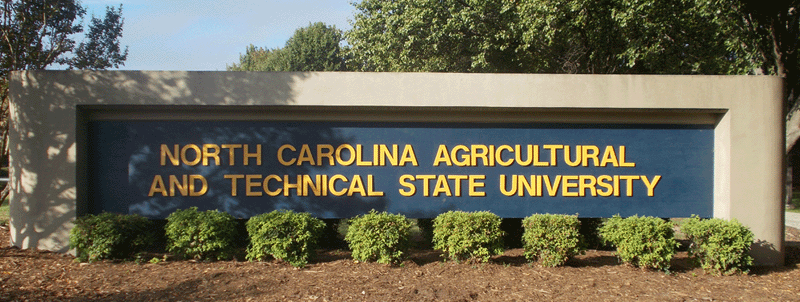 |
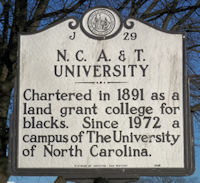 North
Carolina Agricultural and Technical
State University (NC A&T) was
established as the A&M college for
the "Colored Race" in 1891.
HBCU NC A&T, one
of the state's two land grant
institutions, has programs throughthe
doctoral level. Its programs include
engineering, arts and sciences,
agricultural and environmental
sciences, business and economics,
education, nursing, technology, and
graduates studies. “
The expected roles of a land- North
Carolina Agricultural and Technical
State University (NC A&T) was
established as the A&M college for
the "Colored Race" in 1891.
HBCU NC A&T, one
of the state's two land grant
institutions, has programs throughthe
doctoral level. Its programs include
engineering, arts and sciences,
agricultural and environmental
sciences, business and economics,
education, nursing, technology, and
graduates studies. “
The expected roles of a land-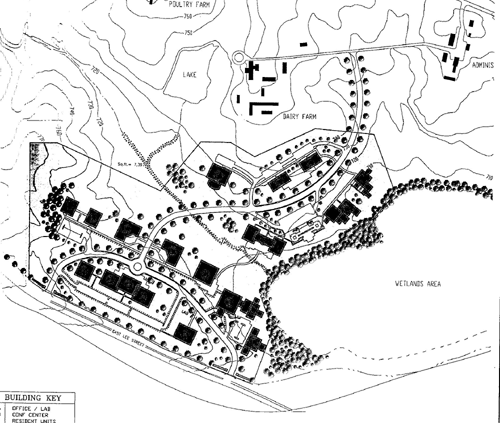 grant institution,
is teaching agriculture and
engineering, and providing
cooperative extension services”. NC
A&T's 2001 amend University Master
Plan called for developing 75 acres
of land along East Lee Street
targeted to develop new
opportunities for both research and
education in both the private and
academic arenas between the
University's technology and
agricultural research and its
students, which didn't include
across-town historical white UNC
Greensboro and its affiliated
members of the Greensboro business
community. grant institution,
is teaching agriculture and
engineering, and providing
cooperative extension services”. NC
A&T's 2001 amend University Master
Plan called for developing 75 acres
of land along East Lee Street
targeted to develop new
opportunities for both research and
education in both the private and
academic arenas between the
University's technology and
agricultural research and its
students, which didn't include
across-town historical white UNC
Greensboro and its affiliated
members of the Greensboro business
community. |
|
Nanotechnology, Nanoscience and
Nanoengineering, should have been
HBCU NCA&T Signature Programs
|
|
“Signature programs” have
been defined as those that
are distinctive, that build on
existing strengths,
that advance the
institution’s profile, and
that serve regional and/or
state economic
transformation needs." |
|
"It is predicted that nano scale
science will change the nature of
almost every human-made product this
century. This field has great
potential applications in materials,
medicine, electronics, optics, data
storage, advanced manufacturing,
environment, energy, and national
security. PCG/UNC-NCCS/UNC
Interim report3. doc/RB.SP.PC.CR.Atpcc.I
/CC.14/10May05 page 109] |
| |
|
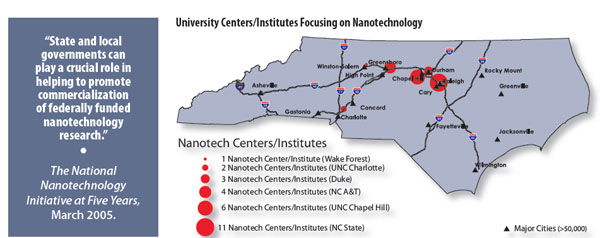
 Historical
Black Land Grant NC A&T was listed
as University focus on
Nanotechnology May 2005. Historical
Black Land Grant NC A&T was listed
as University focus on
Nanotechnology May 2005.
Crosstown PWI UNC
Greensboro was not listed as a
University focused on Nanotechnology
and Gateway University Research Park
did not exist. |
|
Nanotechnology is
Experimental. |
| .Although
these nascent nanoscale
technologies are still
largely experimental, their
growth is similar to that of
the now maturing biotech
industry, which has
established a significant
record of accomplishment for
product approval and
manufacturing. [5] |
 |
 |
|
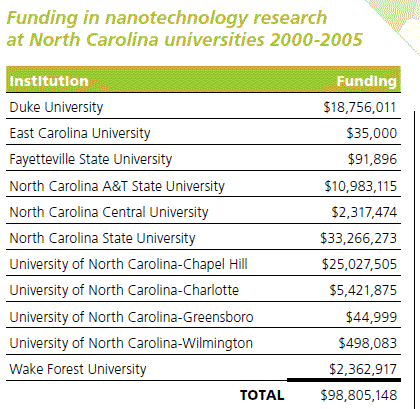
NC A&T was 4th
in
Nanotechnology
Research at
North
Carolina Universities |
|
with $11 Million
Dollars between
2000-2005 and
UNC Greensboro
was 11th out of
12 with $44,999.
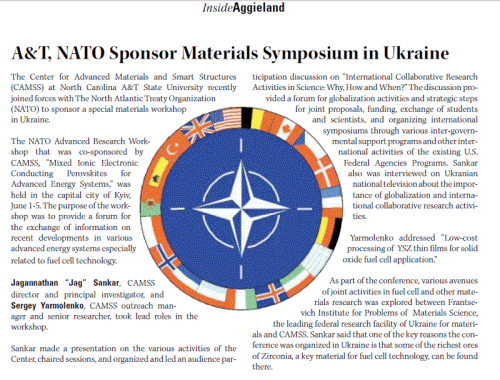
In 2003 A&T,
NATO Sponsor
Material
Symposium in
Ukraine. |
|
|
| |
|
Cannibalizing
and Marginalizing NC A&T Praise |
|
 |
|
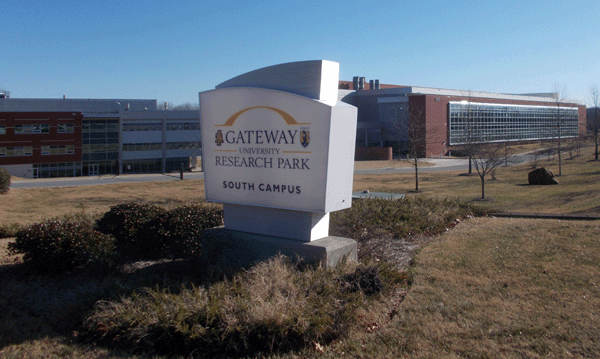
"A Promise for the Future By
some accounts,
nanotechnology is destined
to replace much of today's
technology. Gateway
University Research Park
expects to be at the
forefront of these new
technologies with the
creation of a new
institution the
Joint School for Nanoscience
and Nanoengineering
(JSNN)" 15] |
|
|
| |
The [UNC-G] Associate Provost for Research and
Partnerships serves on the  Government
Relations council for the Greensboro Partnership
and through this role contributed to the
lobbying efforts with the state legislators for
funding for the Joint School of Nanoscience and
Nanoengineering. The College [College of Arts
and Sciences] was a central player in the
continuing work to establish the Joint School of
Nanoscience and Nanoengineering with NCA&T
University. Degrees or programs being considered
for the future· MS in Nanoscience and Ph.D. in
Nanoscience. [UNC-G Curricular Planning,
Academic Affairs Annual Report AY 2007/08]
Emphasis added. Government
Relations council for the Greensboro Partnership
and through this role contributed to the
lobbying efforts with the state legislators for
funding for the Joint School of Nanoscience and
Nanoengineering. The College [College of Arts
and Sciences] was a central player in the
continuing work to establish the Joint School of
Nanoscience and Nanoengineering with NCA&T
University. Degrees or programs being considered
for the future· MS in Nanoscience and Ph.D. in
Nanoscience. [UNC-G Curricular Planning,
Academic Affairs Annual Report AY 2007/08]
Emphasis added. |
| |
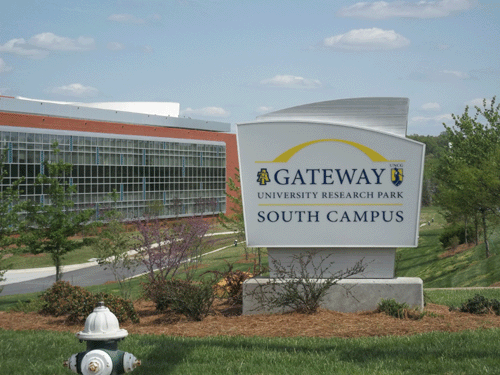  " I
am so energized by the potential of this research
park, in particular the joint schools of
nano technology and nano science. The world is
seeing explosive growth today in the
commercialization of nanotechnology. We will
have all of the assets right here in Guilford
County that we need to participate in that
explosion, and they will be right here at the Gateway
University Research Park." said ("Greensboro
Boy" ) Erskine Bowles President of the
University of North Carolina System. [2]. " I
am so energized by the potential of this research
park, in particular the joint schools of
nano technology and nano science. The world is
seeing explosive growth today in the
commercialization of nanotechnology. We will
have all of the assets right here in Guilford
County that we need to participate in that
explosion, and they will be right here at the Gateway
University Research Park." said ("Greensboro
Boy" ) Erskine Bowles President of the
University of North Carolina System. [2].
|
The National Center for
Educational Statistics (NCES) responsible for
collecting and presenting statistical data and
information for the nation; classifies
Nanoscience and Nanoengineering as
Nanotechnology CIP 15.1601: Engineering
technologies and Engineering related fields.
|
For Liberal Arts UNC Greensboro with doctorial
programs in music and nursing to offer
Nanoscience degrees requires access to NC A&T
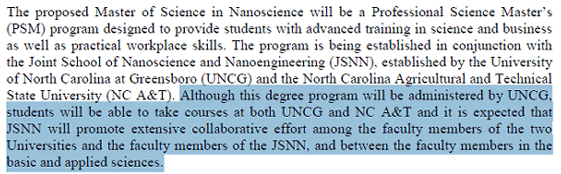
academic programs and research: “Although the
degree is in Nanoscience (does not include
Nanoengineering)

students will be given the opportunity to take
relevant courses at the School
of Engineering at North Carolina A&T University
and must be able to work on collaborative
projects with faculty in the School of
Engineering.
|
UNC Policy for
Interdisciplinary Degree

An Interdisciplinary Degree program
involves two or more academic units,
either on the same or
different campuses in a formal
agreement to offer a program of
study drawing on two or more
disciplines that will result in a
student being awarded an
interdisciplinary degree. If more
than one campus is involved in
offering the program it would also
be a joint degrees.
|
|
|
|
| |
|
A degree
program is a program of
study in a discipline
specialty that leads to a
degree in that distinct
specialty area at a
particular level of
instruction. As a general
rule, in order to be
considered for degree
program status, a course of |
|
 |
|
study should
require at least 27 semester
hours in the proposed
program area at the
undergraduate level; at
least half the number of
hours required for the
degree at the master’s
level; at least 21 hours in
the proposed program area at
the doctoral level. |
|
| |
Doctor of
Philosophy in
Nanoscience
The PhD in
Nanoscience requires
a minimum of 60
hours and is
designed to prepare
students to take
positions in
industrial,
governmental, or
academic research
settings by
providing a solid
background in
Nanoscience theory
and experimental
techniques through
course work and
dissertation
research. |
|
| |
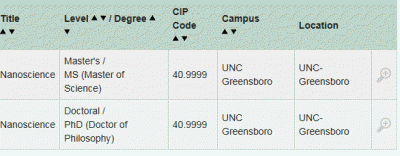
| Notwithstanding the National Center for Educational Statistics (NCES), categorized Nanoscience as CIP 15.1601 Engineering Technologies and Engineering-Related Fields. UNC General Administration applied CIP 40.9999 (Physical Science) to UNCG academic offering . Note UNC-G has a School of Arts and Science. |
 |
|
| Note Fall 2005 UNC Presidency transition from President Molly Broad to Erskine Bowles. |
|
Erskine Bowles UNC General Administration categorizing Nanoscience Ph.D. as a Physical Science; examining UNC Greensboro curricula for similar Physical Science Ph.D. programs determined: |
 |
|
UNC Greensboro offer no similar Ph.D. programs in 40 CIP category. |
|
|
|
|
|
|
|
|
|
| |
Dr. Belle Wheelan
SACS Commission on Colleges, letter
dated June
25, 2010 to
Dr. Alton Thompson (NCA&T) and Dr.
David H. Perrin (UNCG), thank them
for letter dated May 24, 2010 and
prospectus for the M.S. and Ph.D.
degrees in nanoscience, a part of
the curriculum sponsored by the
joint venture of the two
institutions housed in the Joint
School of Nanoscience and
Nanoengineering (JSNN)
|
 |
"We approve the M.S. and Ph.D.
degree programs in Nanoscience,
shall include them within the scope
of accreditation previously granted
to the University of North Carolina
at Greensboro”. |
|
| |
UNC Board of Governors 2007-09
budget Priorities bogus claiming
the Greensboro Center for Innovative
Development- renamed Gateway
University
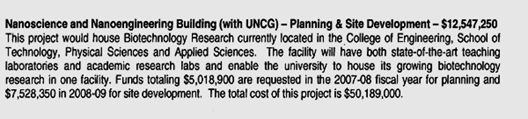
as NCAT/UNC-G
Joint Millennial Campus relocated
NCA&T College
of Engineering, School
of Technology, Physical
Sciences and Applied Sciences
programs and research, off
–campus to the bogus Joint
Millennial (with UNCG) |
| |
| In addition to
degree programs in nanoscience and
nanoengineering, JSNN will engage in
research and outreach, as well as
the expected roles of a land-grant |
|
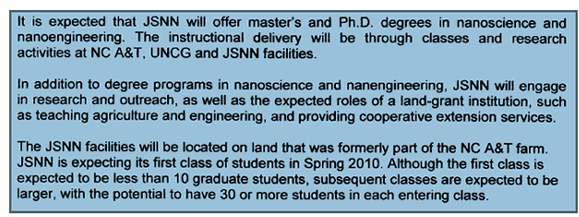 |
| Research Park institution,
such as teaching agriculture and
engineering, and providing
cooperative extension services. The
JSNN facilities will be located on
land that was formerly part of the
NC A&T farm. |
| |
UNCG will act as the
financial manager for JSNN
beginning in fiscal year
"09-'10, using a budget
accounting code established
for JSNN. JSNN will follow
all UNCG Budget and fiscal
management policies and
procedures. NC A&T will be
designated as the campus
responsible for the upkeep
of the buildings, but upon
receipt of the Building
Operation and Maintenance
money for JSNN, will
transfer the money to
Gateway University Research
park in accordance with the
Management Services and
Development Agreement
between Gateway, NC A&T and
UNCG [36]
|
|
 |
|
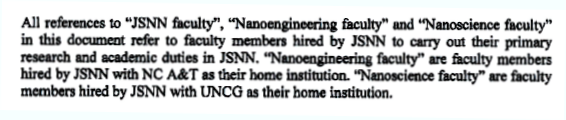
All references to
"JSNN faculty,
Nanoengineering
faculty and
Nanoscience faculty
in this document
refer to faculty
members hired by
JSNN to carry out
their primary
research and
academic duties in
JSNN.
"Nanoengineering
faculty are faculty
members hired by
JSNN with NC A&T as
their home
institution.
Nanoscience faculty
are faculty members
hired by JSNN with
UNCG as their home
institution. |
|
|
|
|
|